
What’s New?
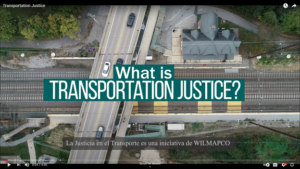
- Click on the image below to see our video about transportation justice.
Introduction
Our Transportation Justice (TJ) initiative identifies key social inequities in the Wilmington region’s transportation system. We examine the fairness and inclusivity of the existing and planned system, as well as our public engagement processes. Recommendations are
made to overcome observed barriers and inequities.
Our TJ initiative exceeds several federal statutes and initiatives: Title VI of the Civil Rights Act, Environmental Justice, Language Assistance, and the Americans with Disability Act.
As an agency, we are committed to incorporating Title VI throughout our planning process. Contracts with third-party firms, as well as our personnel manual, feature all federally-required non-discriminatory clauses and Disadvantaged Business Enterprises (DBE) assurances.
Reports
- 2019 Transportation Justice Plan: A Title VI, Environmental Justice, Americans with Disability Act, and Language Assistance Plan for the WILMAPCO Region
Click on image to view report.
- 2020 Urban Technology Desert Data Report for the WILMAPCO Region
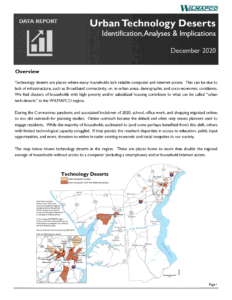
Click on image to view report.
- 2023 Transportation Justice Bus Connectivity Analysis
Media Coverage & Features
- Spotlight Delaware: Addressing Transportation Inequities in Wilmington, September 2024
- FHWA GIS in Transportation Newsletter: “Spotlight: Equity in Transportation,” Spring 2023
- FHWA TPCB: “Case Study: The Wilmington Area Planning Council’s Transportation Justice Initiative,” March 2022
- Transit Equity Day 2022 Livestream with the Delaware Sierra Club
- Poster Session at the 2021 Transportation Research Board’s Conference on Advancing Transportation Equity
- WHYY Story, August 14, 2019
- Delaware Public Media Story, August 16, 2019
- Delaware Business Times Story, September 16, 2019
- State of Transportation Planning 2020 — Moving People Over Cars: Mobility for Healthy Communities. The American Planning Association, Transportation Planning Division. “Tackling and Racial and Class Transportation Inequities in the Wilmington, Delaware Region.” Pages 62-68.
Interactive Map Series
Several of the maps in the 2019 Transportation Justice Report are also available as online interactive maps, via the links below.
- Supermarket Connectivity
- Pharmacy Connectivity
- Hospital Connectivity
- Library Connectivity
- Low Wage Employment Center Connectivity
- Medical Center Connectivity
- Community Center Connectivity
- Senior Center Connectivity
- State Service Center Connectivity
- LEP and LL Clusters
- EJ Neighborhoods
- MC Neighborhoods
- Food Deserts – Transit to Supermarket
- ARCCA Pedestrian and Transit Analysis
Historic Environmental/Transportation Justice Reports
- 2019 – Transportation Justice Plan
- 2015 – Transportation Justice: Accessibility and Mobility Report
- 2013 – Environmental Justice & Title VI: Transportation Equity Report
- 2009 – Environmental Justice: Transportation Equity Report
- 2007 – Transportation Justice: Accessibility and Mobility Report
- 2003 – Environmental Justice: Transportation Equity Analysis for the WILMAPCO Region