
Air Quality Partnership of Delaware

Welcome to the Air Quality Partnership of Delaware
The mission of the Air Quality Partnership of Delaware, a public / private coalition of businesses, agencies, and individuals interested in clean air, is to raise awareness and inform Delawareans about practices that improve air quality and health. Ground level ozone and particulate matter (PM 2.5) are both caused by pollutants in the air, frequently the result of vehicle or industrial emissions. They can result in health problems, particularly for sensitive groups, such as seniors, children and people with respiratory problems.
Check out this Air Quality Webinar!
Learn about The Air Quality Partnership of Delaware (AQP) and the partners in this webinar sponsored by Delaware Commute Solutions. Plus, learn about Delaware’s Air Quality and how it is monitored in our state. Special Guest from the Division of Air Quality under Delaware’s Department of Natural Resources and Environmental Control. Click on the graphic below to view the webinar.
New “Care for the Air” Video!
Tropo is a friend of the AQP and Delaware. Tropo is here to help raise awareness about how the air we breathe affects our health, and how the things we do can impact the air we breathe. Click on the image below to learn with Tropo how simple steps, including: carpooling, walking, biking, taking public transit, and turning off the car engine when you stop for more than two minutes, can make a big difference to help reduce air pollution.
If you’d like Tropo to visit your school or event, please write to Helen: Helen.Wiles@doverkentmpo.org
Sign up for Air Quality Email Alerts
To signup to for notifications of Air Quality Action Days, when the ozone or PM2.5 levels are expected to reach unhealthy levels, please visit: www.enviroflash.info.
On AIR QUALITY ACTION DAYS we urge you to limit your time outdoors during the afternoon, when ozone is typically at its highest levels. On these days, don’t fill up your gas tank until after sunset, don’t mow your lawn or use a BBQ grill and limit the use of your car – carpool, bring your lunch to work, ride transit, etc.
- Take Transit: ride the bus, train, subway or trolley to work
- Ride share: join a carpool or vanpool. Visit Delaware Commute Solutions, to learn more
- Telecommute: work from home and spend your extra commute hours with your family
- “Trip-link”: do all errands at one time, avoiding unnecessary cold starts. An engine that’s been sitting for an hour or more pollutes five times as much as a warm one.
- Don’t “top off” your fuel tank. This is never a good idea, no matter what time of day. Spillage adds about two tons of pollution a day to our air.
- Turn off your engine when you stop your car for a minute or more.
- Postpone mowing the lawn until late in the day or use a manual or electric mower instead. (And remember to refuel mowers and other gasoline-powered tools after dusk too).
- Start your barbecue with an electric probe, charcoal “chimney” or use a gas grill. Charcoal lighter fluid vaporizes quickly and adds to air pollution.
- Use latex paints -rather than oil-based-and avoid daytime use of pollutants.
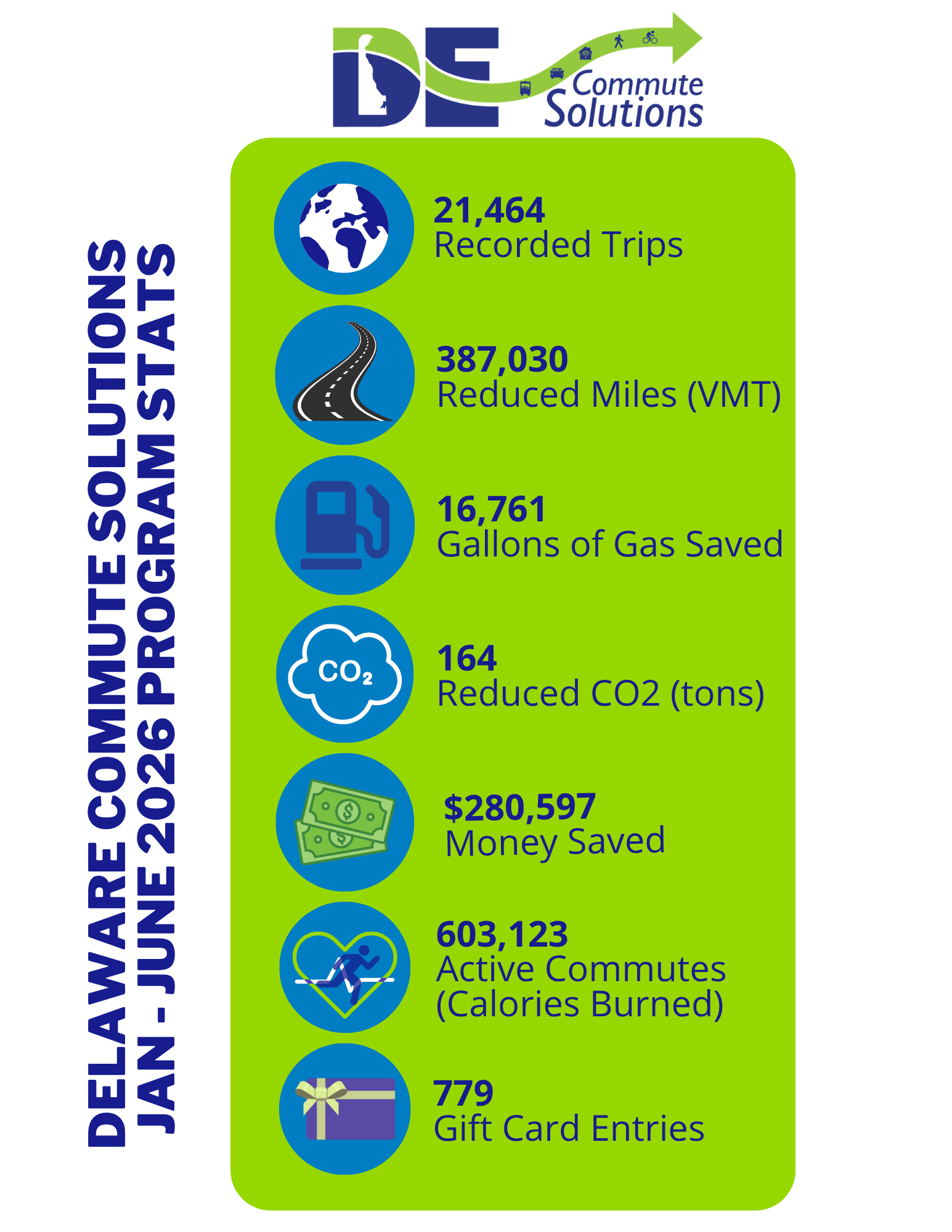
Delaware Commute Solutions Stats
Carpooling really can make a different in our air quality, our wallet, and our health. Check out these clean commuting stats from Delaware Commute Solutions, a free commuter resource program.
Join the Partnership
You or your organization can play an important role in reducing the impact of poor air quality by working with us to educate Delawareans about simple steps that can be taken to “Do Their Share for Cleaner Air.” These steps, when taken by many people, reduce the incidence of high ozone days, resulting in a reduction in lung-related illnesses, lower health care costs, reduced employee absenteeism, and families that are happier and healthier. For more information, please contact Helen at 302-387-6026 or email Helen.Wiles@doverkentmpo.org
The Air Quality Partnership of Delaware is on Facebook!
The Partners
Ozone
Ground level ozone, or smog, is air pollution that is particularly dangerous on hot summer days. It is caused by emissions from cars and other gasoline engines combining with sunlight and heat. On days when the temperature is high and the air is still, these emissions (NOx and VOCs) create a harmful mix called ground level ozone.
It can affect everyone. The average adult breathes over 3,000 gallons of air every day. Children breathe even more air per pound of body weight and are more susceptible to air pollution. Also, they play outside more and are exposed to greater quantities, compared to adults. Groups especially sensitive to air pollution include: children, the elderly, people with heart and lung diseases, and in the summer, adults who exercise or work outside.
In the short-term, exposure to high levels of ozone irritates the lung’s airways and causes inflammation, much like a sunburn. Other symptoms include coughing, wheezing, chest pain and headaches. It can aggravate chronic respiratory diseases such as asthma and bronchitis and can lead to increased emergency room visits and hospital admissions. Long-term, prolonged exposure to even low levels of ozone can cause asthma in children and lead to permanent lung damage.
To help you know if the air outside is safe, we forecast air quality every day from May-September. Watch the news, visit our website or check your local newspaper to see what the Ozone level is each day.
Scroll to see more
|
Air Quality Index(AQI) |
Level of Health Concern |
Protective Measures |
| GREEN | Good | No health impacts expected. |
| YELLOW | Moderate | Unusually sensitive people should consider avoiding prolonged outdoor activity. |
| ORANGE | Unhealthy for Sensitive Groups | For Ozone: Sensitive groups (including children, the elderly, persons with respiratory conditions and adults who exert themselves or work outdoors) should limit outdoor activity. For Particle Pollution: Sensitive groups (including children, the elderly, persons with respiratory AND heart conditions) limit their outdoor AND indoor activity. |
| RED | Unhealthy | For Ozone: Everyone should avoid prolonged outdoor exertion. For Particle Pollution: Everyone should avoid prolonged outdoor AND indoor exertion. |
PM 2.5
Particulate Matter refers to tiny particles that are emitted into the air. Our region was determined to be in non-attainment for Particulate Matter 2.5 (PM2.5). This means, the particles are 2.5 microns, about 1/14 the width of a human hair. Because they are so small, they get imbedded into the lining of our lungs and cause health problems.
Unlike ozone, PM2.5 levels don’t rely on sunlight to create unhealthy air. Therefore reach dangerous levels any time during the day and all year round. In addition to respiratory problems, exposure to PM can cause cardio damage as well.
Links
- www.youtube.com/watch?v=tnR7byHOOLA – video about the Air Quality Index
- www.airnow.gov – a time-lapsed image of ozone in our region. Click the map you want and then click “See this map in motion.”
- www.airqualitypartnership.org – information on what you can do to help reduce the harmful effects of ozone or PM 2.5
- https://dnrec.alpha.delaware.gov/air/quality/ozone – to learn more about Ozone
- https://www.wilmapco.org/aq – to learn more about air quality in the WILMAPCO region